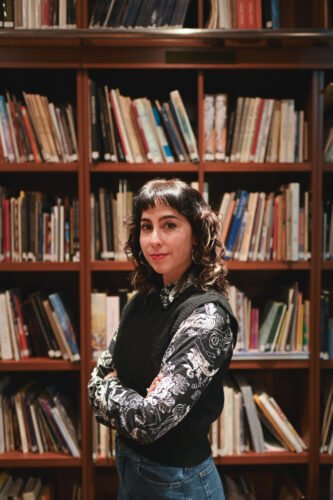
Jazmín Adler es historiadora del arte, curadora e investigadora. Nació en Buenos Aires, Argentina, donde actualmente vive y trabaja. Es Doctora en Teoría Comparada de las Artes por la Universidad Nacional de Tres de Febrero (UNTREF) y Licenciada en Artes por la Facultad de Filosofía y Letras de la Universidad de Buenos Aires (UBA).
Su campo de investigación abarca las relaciones entre el arte, la ciencia y las tecnologías; las omisiones historiográficas en las narrativas canónicas de la historia del arte tecnológico, principalmente aquellas que vinculan la escena latinoamericana con los relatos del Norte Global; y las conexiones entre arte, tecnología, política y materialidad en Latinoamérica. Estos temas han sido desarrollados en el marco de sus investigaciones de doctorado y postdoctorado, ambas financiadas por becas del Consejo Nacional de Investigaciones Científicas y Técnicas de Argentina (CONICET).
Es directora del Programa de Actualización de Posgrado «Tecnologías en el Arte Contemporáneo», en la Facultad de Filosofía y Letras de la UBA. Profesora titular del Departamento de Arte y Cultura de UNTREF. Allí dicta clases en la Licenciatura y la Maestría en Artes Electrónicas (UNTREF), así como en la Maestría en Curaduría. Asimismo es docente de la Maestría en Fotografía (UNSAM).
Integra el Colectivo Ludión: exploratorio latinoamericano de poéticas/políticas tecnológicas (Facultad de Ciencias Sociales, UBA); el Comité Académico de la Especialización en Medios y Tecnologías para la Producción Pictórica (UNA), el equipo de revisión por pares de Leonardo (MIT Press) y el comité asesor del CIFO-Ars Electronica New Media Grants & Commissions Award.
Entre otras publicaciones, es autora de los libros Arte, Ciencia y Tecnología en el ICI-CCEBA: del impulso del video a las inteligencias artificiales (2021) y En busca del eslabón perdido: arte y tecnología en Argentina (2020), así como compiladora de Desmantelando la máquina: transgresiones desde el arte y la tecnología en Latinoamérica (2021).
Durante los últimos años, ha formado parte del Comité Académico de Selección de ISEA – International Symposium on Electronic Art, integró el equipo de coordinación del Apoyo al Arte Contemporáneo del MediaLab del Centro Cultural de España y fue jurado del Programa Synergies (Pro Helvetia, Suiza), del Premio CIFO-Ars Electronica (EEUU/Austria), del Salón Nacional de Artes Visuales, el Premio Itaú, el Concurso Federal Arte, Ciencia, Tecnología e Innovación, y la selección de propuestas curatoriales para integrar la programación del Museo de Arte Contemporáneo y la Galería Gabriela Mistral de Santiago de Chile.
Entre las becas y premios recibidos, se destaca la beca de investigación postdoctoral del Deutscher Akademischer Austauschdienst (DAAD) en el programa de nuevos medios de la Universität der Künste, Berlín; el Premio Hugo Padeletti. Estímulo a la investigación en el campo de las Artes, otorgado por el Museo Rosa Galisteo de Rodríguez, dependiente del Ministerio de Cultura de la Provincia de Santa Fe; y la beca de investigación postdoctoral en el Getty Research Institute (Los Ángeles, Estados Unidos), otorgada por Fundación Bunge y Born y Centro Espigas.
Entre sus últimos proyectos curatoriales se encuentran la Bienal de Artes Multimediales de Quito (Ecuador); Gyula Kosice. En tiempo real (Museo Castagnino, Rosario); Soberanía de las cosas (Palacio Libertad – ex CCK); Desvíos: subvertir las inteligencias artificiales (EAC, Montevideo); y Planetary Atoll: Connecting Latin American Dots (panke.gallery y SAVVY, Berlín).
Jazmín Adler is an art historian, curator, and researcher. She was born in Buenos Aires, Argentina, where she currently lives and works. She holds a PhD in Comparative Theory of the Arts from the National University of Tres de Febrero (UNTREF) and a BA in Art History from the Faculty of Philosophy and Letters at the University of Buenos Aires (UBA).
Her research focuses on the relationships between art, science, and technology; historiographical omissions in canonical narratives of the history of technological art, particularly those concerning the connections between the Latin American scene and narratives originating in the Global North; and the intersections of art, technology, politics, and materiality in Latin America. These areas have been developed through her doctoral and postdoctoral research, both funded by fellowships from Argentina’s National Scientific and Technical Research Council (CONICET).
She is Director of the Postgraduate Program Technologies in Contemporary Art at the Faculty of Philosophy and Letters, University of Buenos Aires. She is a tenured professor in the Department of Art and Culture at UNTREF, where she teaches in the undergraduate and graduate programs in Electronic Arts, as well as in the MA in Curatorial Studies. She also teaches in the MA in Photography at the National University of San Martín (UNSAM).
She is a member of Colectivo Ludión: Latin American Exploratory Group on Technological Poetics/Politics (Faculty of Social Sciences, UBA); the Academic Committee of the Specialization Program in Media and Technologies for Pictorial Production (UNA); the peer-review team of Leonardo (MIT Press); and the advisory committee of the CIFO-Ars Electronica New Media Grants & Commissions Award.
Her publications include the books Arte, Ciencia y Tecnología en el ICI-CCEBA: del impulso del video a las inteligencias artificiales (2021) and En busca del eslabón perdido: arte y tecnología en Argentina (2020), as well as the edited volume Desmantelando la máquina: transgresiones desde el arte y la tecnología en Latinoamérica (2021).
In recent years, she has served on the Academic Selection Committee of ISEA – International Symposium on Electronic Art; was part of the coordination team for the Contemporary Art Support Program of the MediaLab at the Cultural Center of Spain; and has served as a juror for the Synergies Program (Pro Helvetia, Switzerland), the CIFO-Ars Electronica Award (USA/Austria), the National Visual Arts Salon, the Itaú Award, the Federal Competition for Art, Science, Technology and Innovation, and the selection of curatorial proposals for the programming of the Museum of Contemporary Art and the Gabriela Mistral Gallery in Santiago, Chile.
Among the fellowships and awards she has received are a postdoctoral research fellowship from the Deutscher Akademischer Austauschdienst (DAAD) in the New Media Program at the Berlin University of the Arts (UdK Berlin); the Hugo Padeletti Award for Research in the Arts, granted by the Rosa Galisteo de Rodríguez Museum, under the Ministry of Culture of the Province of Santa Fe; and a postdoctoral research fellowship at the Getty Research Institute (Los Angeles, USA), awarded by Fundación Bunge y Born and Centro Espigas.
Her recent curatorial projects include the Quito Biennial of Multimedia Arts (Ecuador); Gyula Kosice. En tiempo real (Castagnino Museum, Rosario); Soberanía de las cosas (Palacio Libertad, formerly CCK); Desvíos: subvertir las inteligencias artificiales (EAC, Montevideo); and Planetary Atoll: Connecting Latin American Dots (panke.gallery and SAVVY, Berlin).